
Are Developers Losing Their Technical Edge to Vibe Coding
Not even close ... This is why.

There’s a new breed of “developer” emerging. They ship fast. They build products. They celebrate wins on Twitter. But ask them to explain how their code works, and you’ll get vague hand-waving about “it just works” and “AI figured it out.”
Welcome to vibe coding! This term was created by OpenAI co-founder Andrej Karpathy. It encourages developers to “fully give in to the vibes, embrace exponentials, and forget that the code even exists.”
Why spend years learning computer science? ChatGPT can write your code for you! Why debug when you can regenerate? Why understand algorithms when AI handles optimization?
But, vibe coders aren’t winning. They’re accumulating technical debt at a crazy fast rate.
What Is Vibe Coding?
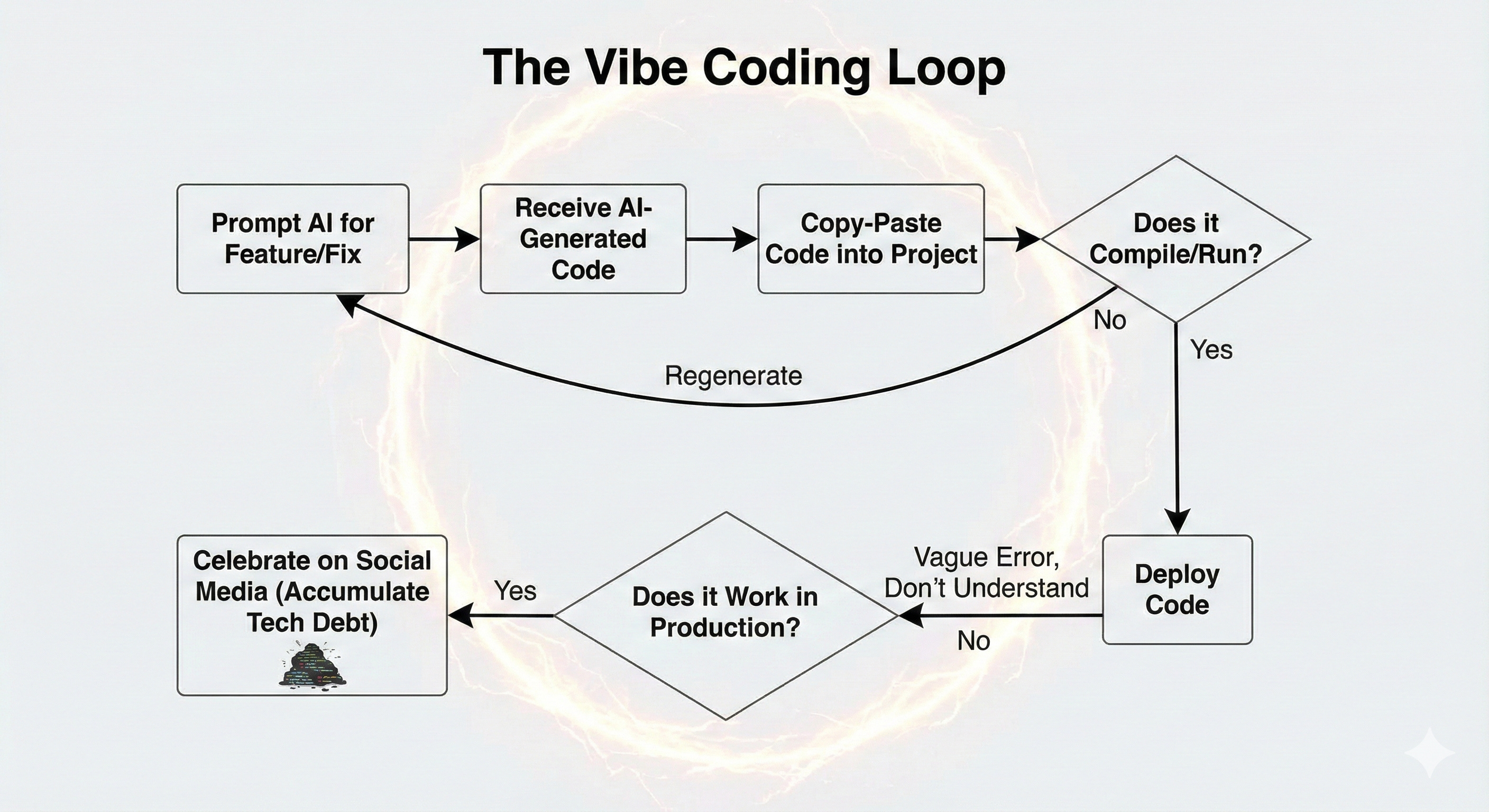
Vibe coding is development driven by intuition over understanding. It’s copying AI-generated code without knowing why it works. It’s prompting assistants until something compiles. It’s shipping code you can’t explain, maintain, or debug.
The adoption is massive: AI now generates 41% of all code written globally, 256 billion lines in 2024 alone. A quarter of Y Combinator’s Winter 2025 batch has codebases that are 95% AI-generated.
These founders are not non-technical. YC managing partner Jared Friedman said, “Every one of these people is highly technical and can build their own products from scratch.”
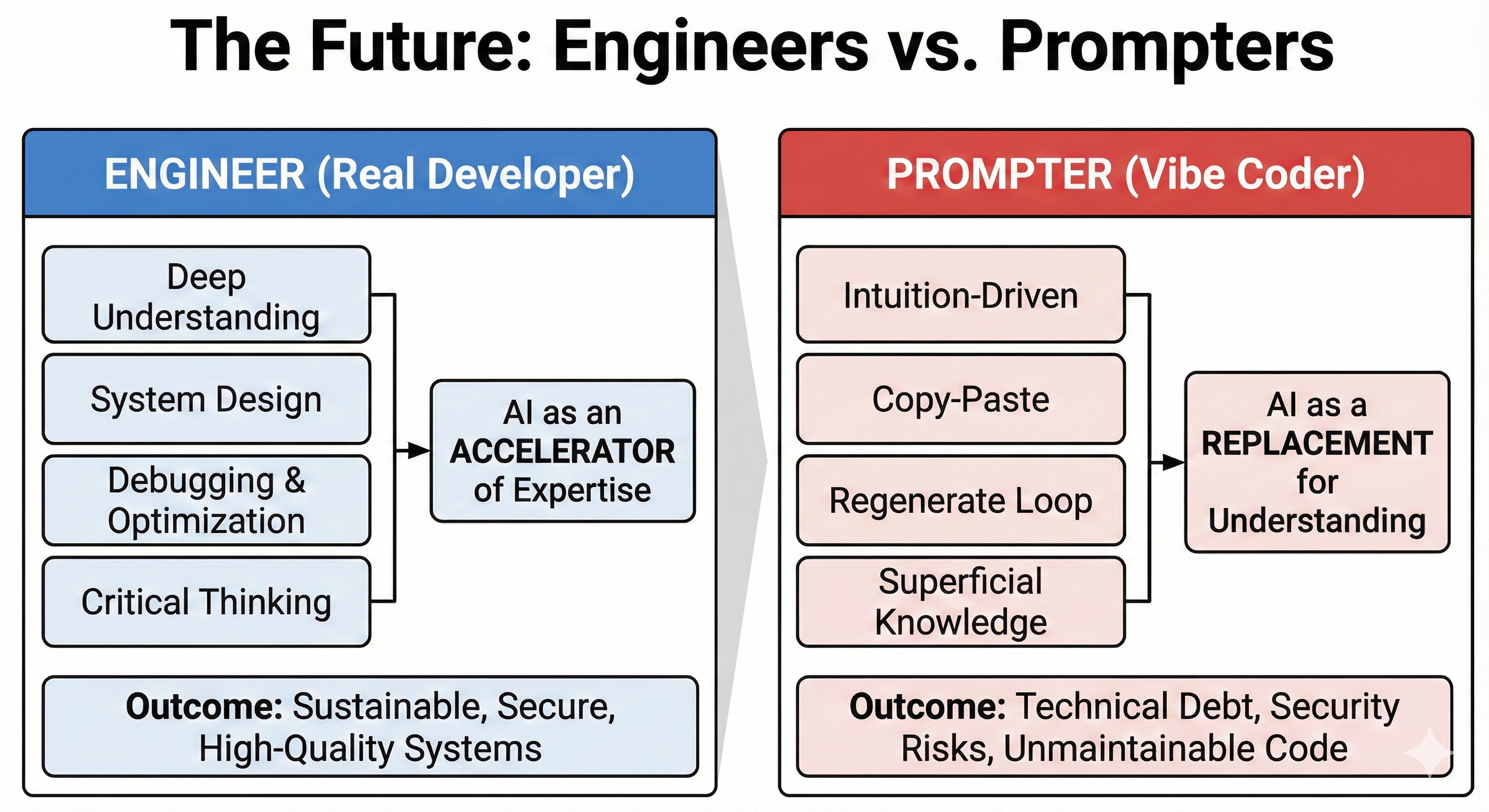
The problem isn’t using AI tools. The problem is replacing comprehension with convenience. Real developers use AI to accelerate work they understand. Vibe coders use AI to avoid understanding entirely.
The Illusion of Productivity
Vibe coding feels productive. You’re shipping features. Closing tickets. Meeting deadlines. Tools like GitHub Copilot boast 51% faster coding speeds and 26% more completed tasks.
Until you face “an outage a week,” as noted by a financial services CTO. His developers stopped taking responsibility for AI-generated code.
GitClear’s analysis of 211 million code changes reveals the scope of the crisis:
Code duplication increased 8-fold during 2024.
Code churn (revisions within two weeks) is projected to double from pre-AI baselines.
Refactoring dropped from 25% to less than 10% of changes.
Lines classified as “copy/pasted” rose from 8.3% to 12.3%.
Velocity without comprehension is just accumulated risk.
The metrics lie. Lines of code shipped don’t measure code quality. Features deployed don’t measure maintainability.
The Security Crisis Vibe Coders Created
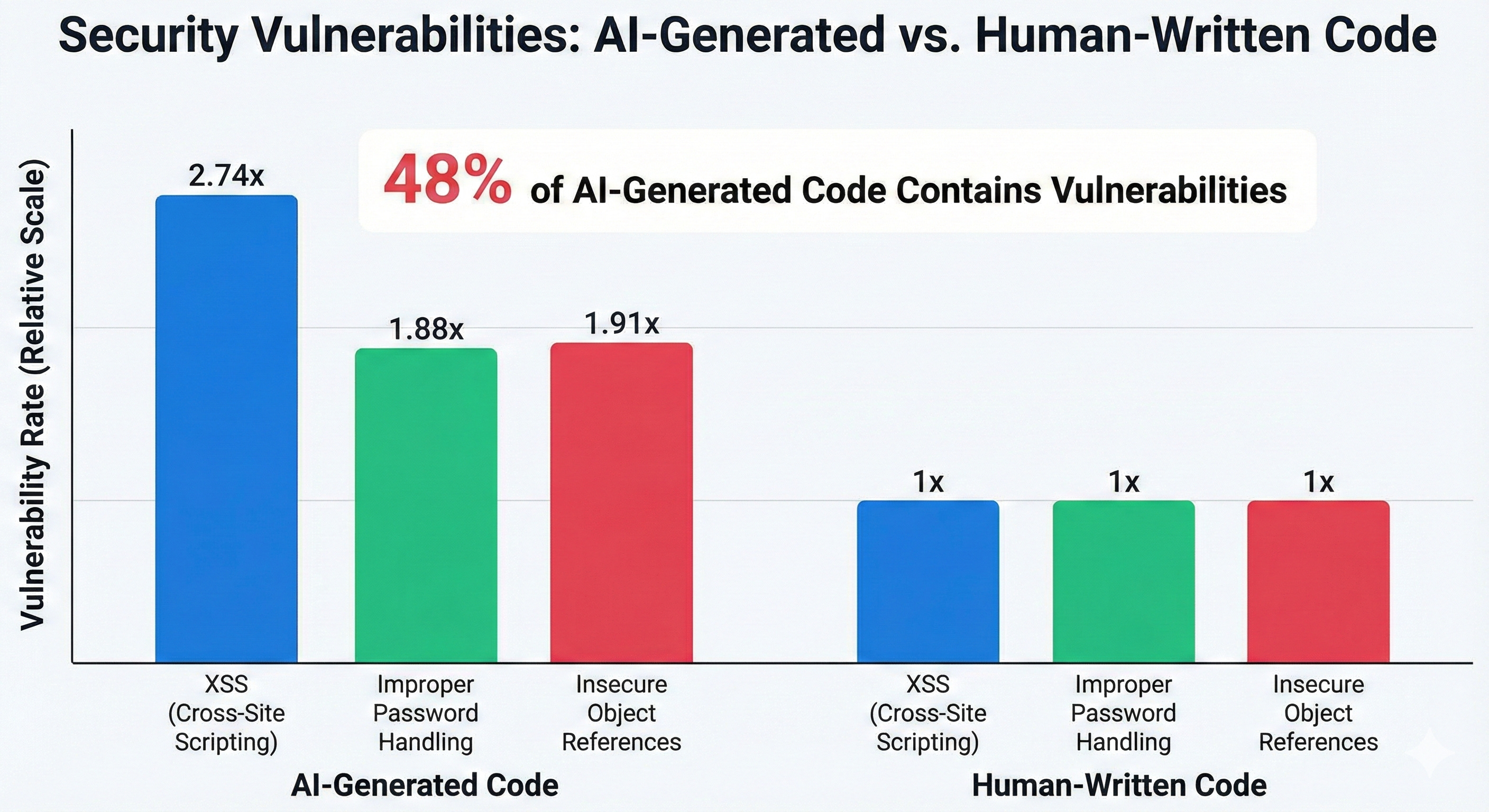
Researchers at Stanford University found that developers who used AI assistants wrote less secure code. They also thought their code was more secure than it actually was. In 4 out of 5 tasks (80%), AI-assisted participants produced more security vulnerabilities.
The numbers are wild:
2.74x more XSS vulnerabilities in AI-generated code.
1.88x more improper password handling.
1.91x more insecure object references.
48% of AI-generated code contains vulnerabilities.
This isn’t theoretical.
Why Traditional Developers Are Better Positioned
Let’s compare two scenarios.
Scenario 1: The Vibe Coder An API endpoint is slow. Prompt: “Make this faster.” AI suggests caching. Copy-paste. Deploy. Success?
Two weeks later, the cache is stale. Users see outdated data. Prompt: “Fix cache staleness.” AI suggests TTL. Deploy. Better?
Now the cache invalidation is inconsistent. Debugging this requires understanding cache coherence, invalidation patterns, and race conditions. The vibe coder has no foundation to reason about this. They’re caught in a loop of prompt, regenerate, and deploy. With each turn, the complexity grows, and they can’t grasp it.
Scenario 2: The Real Developer An API endpoint is slow. The developer profiles it. Discovers N+1 queries. Understands why: each record triggers a separate database call. Knows the solution: eager loading or JOIN optimization. Implements it. Understands the trade-offs: memory usage vs query count. Monitors it. Validates performance gains.
When edge cases emerge, and they always do, the developer has the mental model to diagnose and fix them. No prompting required.
The difference? One understands the system. The other rents understanding from AI.
The Future Belongs to Engineers, Not Prompters
AI isn’t replacing developers. It’s replacing people who thought copy-pasting code made them developers.
The skills that matter:
Debugging complex systems: AI can’t intuit why your distributed cache is inconsistent
System design: AI suggests patterns; you choose the right one for your constraints
Performance Optimization: AI can’t find your bottleneck. You need to measure and analyze it yourself.
Code Review and Mentorship: Knowing if code is good or bad needs both taste and experience.
Andrew Ng, ex-Chief Scientist at Baidu, said skipping programming is “some of the worst career advice ever given.” He stressed that thinking like a programmer is key. It helps in breaking down problems, understanding error messages, and clearly communicating needs. These skills remain vital even in the era of vibe coding.
The Path Forward
Use AI tools. They’re powerful. But build on a foundation of understanding. Learn algorithms. Understand databases. Study system design. Practice debugging. Master your craft.
AI should accelerate your expertise, not replace it.
The developers who thrive won’t be the ones who prompt best. They’ll understand deeply, think critically, and use AI to boost their skills.
Vibe coding is a shortcut to nowhere. Real development is a career.
The technical edge isn’t lost, it’s just more visible. The gap between those who understand and those who copy-paste is widening. On which side do you want to be?
Cheers friends,

Eric Roby
Find me online:
LinkedIn / YouTube / Threads
Sources
Primary Research Studies
GitClear Study (2024): Analysis of 211 million changed lines of code. “AI Copilot Code Quality: 2025 Data Suggests 4x Growth in Code Clones.” https://www.gitclear.com/ai_assistant_code_quality_2025_research
Stanford University Security Study (2024): “Do Users Write More Insecure Code with AI Assistants?” Research by Professor Dan Boneh and PhD candidate Neil Perry involving 47 participants. https://ee.stanford.edu/dan-boneh-and-team-find-relying-ai-more-likely-make-your-code-buggier
GitHub Copilot Research (2024-2025): Productivity and adoption statistics. https://www.secondtalent.com/resources/github-copilot-statistics/
Faros AI Productivity Report (2025): Analysis of 10,000+ developers across 1,255 teams. Referenced in LeadDev article on technical debt.
Google DORA Report (2024): DevOps Research and Assessment examining AI usage and software delivery performance.
Industry Reports and Articles
TechCrunch: “A quarter of startups in YC’s current cohort have codebases that are almost entirely AI-generated” (March 2025). https://techcrunch.com/2025/03/06/a-quarter-of-startups-in-ycs-current-cohort-have-codebases-that-are-almost-entirely-ai-generated/
TechRepublic: “AI-Generated Code is Causing Outages and Security Issues in Businesses” (2024). https://www.techrepublic.com/article/ai-generated-code-outages/
LeadDev: “How AI generated code compounds technical debt” (2024). https://leaddev.com/software-quality/how-ai-generated-code-accelerates-technical-debt
All In Consulting: “How AI-Generated Code Caused a $10,000+ Outage” (Case study).

AlixPartners: “Can AI solve the rising costs of technical debt?” (2024). https://www.alixpartners.com/insights/102jlar/can-ai-solve-the-rising-costs-of-technical-debt/
Expert Opinions
Andrej Karpathy (OpenAI Co-founder): Original “vibe coding” tweet (February 3, 2025).

Andrew Ng (Former Chief Scientist, Baidu): Commentary on learning fundamentals. Referenced in https://www.klover.ai/vibe-coding-karpathy-viral-term-ng-reality-check-klover-first-mover-advantage/
Martin Fowler (Chief Scientist, Thoughtworks): “AI-first approaches could completely change the way people think about programming.” https://www.thoughtworks.com/perspectives/edition36-ai-first-software-engineering/article
Market Data
IBM: “What is Vibe Coding?” https://www.ibm.com/think/topics/vibe-coding
Opsera: “Github Copilot Adoption Trends: Insights from Real Data” (2025). https://opsera.ai/blog/github-copilot-adoption-trends-insights-from-real-data/
IT Revolution: “New Research Reveals AI Coding Assistants Boost Developer Productivity by 26%” https://itrevolution.com/articles/new-research-reveals-ai-coding-assistants-boost-developer-productivity-by-26-what-it-leaders-need-to-know/
Additional References
Medium (ecoemil): “The Rise of Vibe Coding in 2025” https://ecoemil.medium.com/the-rise-of-vibe-coding-in-2025-a-revolution-or-a-reckoning-4c2f7053ceef
Addyo Substack: “AI Won’t Kill Junior Devs - But Your Hiring Strategy Might”
