
Five Frontier Models Shipped in Two Weeks.
Here's What Each One Actually Is.

(references to article listed at the bottom)
Interested in learning how to build MCPs?
I created a video on that using FastMCP.
Find it here
Between 1 July and 16 July 2026, five frontier AI models shipped or came back online. Sixteen days. If you blinked, you missed a full generation of AI tooling.
My rule for weeks like this: read everything, switch nothing. I wrote a post called “Stop Chasing Every New AI Coding Model.” Shiny tool syndrome can waste your time faster than any bug.
So I’m not going to rank these five. I want to hand you the map instead: what shipped, which claims check out, and the pattern underneath the burst. Let’s dive in.
A Full Generation in Sixteen Days
Here is the timeline:
1 July - Claude Fable 5 (Anthropic) returns after a 19-day government suspension
8 July - Grok 4.5 (SpaceXAI) lands, built jointly with Cursor
9 July - GPT-5.6 Sol (OpenAI) reaches general availability after a government review
9 July, the same Thursday - Muse Spark 1.1 (Meta) opens its paid public preview
16 July - Kimi K3 (Moonshot AI) arrives from Beijing at 2.8 trillion parameters

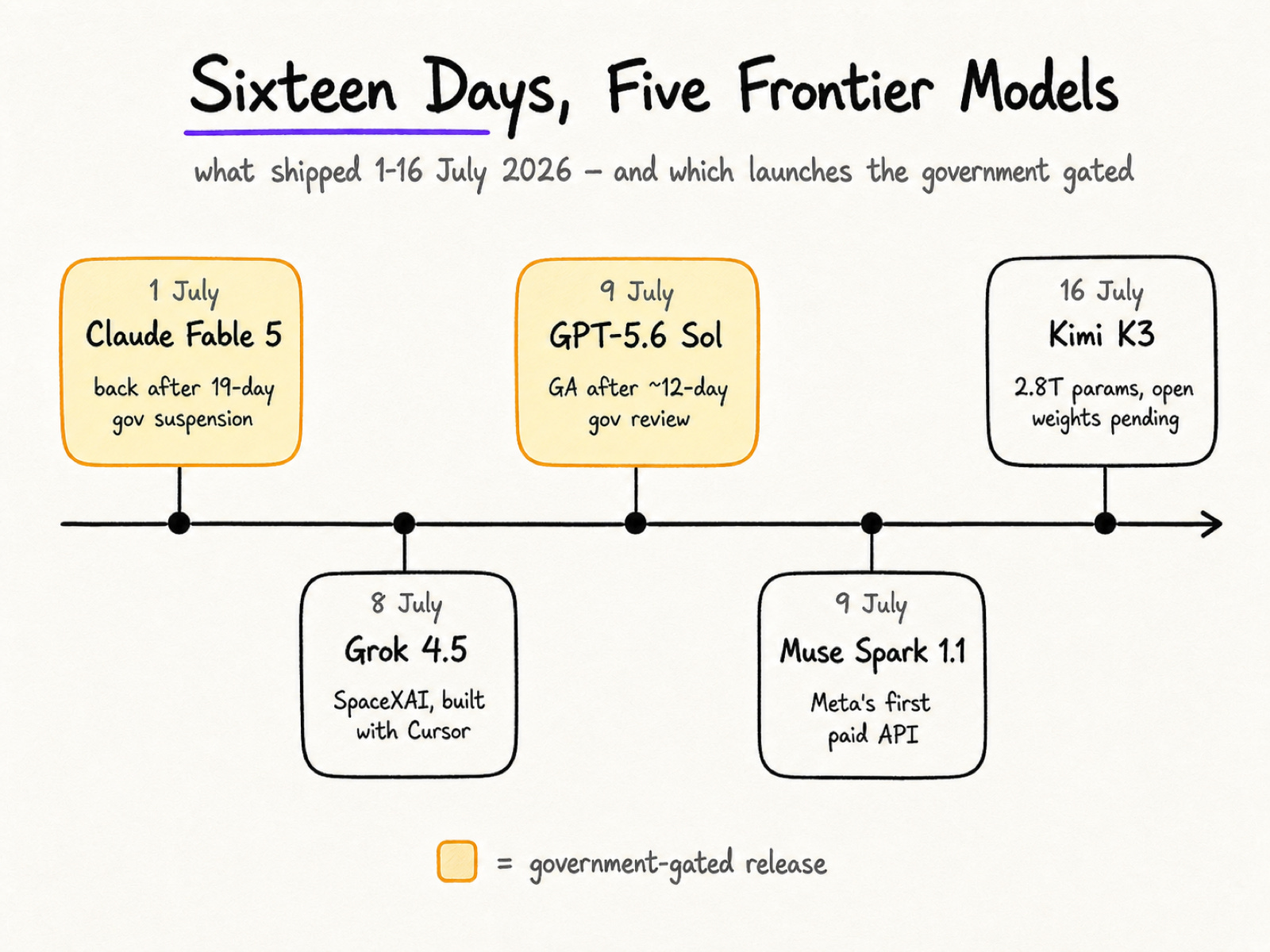
That’s the map. Now the detail, because a few headlines you saw were wrong in small but important ways.
Fable 5 Lived for Three Days, Then Went Dark for Nineteen
Claude Fable 5 first shipped on 9 June 2026. Then researchers at Amazon found a jailbreak around its cybersecurity safeguards. Their report reached the US government, and on 12 June the government put export controls on the model.
That’s when Anthropic pulled the plug. It couldn’t check user nationality in real time. So, it suspended access for everyone, everywhere. If you were building on Fable 5 that week, you lost it overnight.
The controls lifted on 30 June. Fable 5 returned on July 1. Anthropic says its new safety classifier stops the flagged technique more than 99% of the time.
GPT-5.6 Sol Waited Out the White House
OpenAI took a quieter version of the same detour. The GPT-5.6 family - Luna, Terra, and the flagship Sol - went to a small group of trusted partners on 26 June under the White House’s voluntary review framework. It reached everyone on 9 July, after roughly 12 days behind the gate.
OpenAI says Sol is 54% more token-efficient on coding tasks than earlier versions. Vendor math, sure. But it tells you exactly where the lab is aiming.
Grok 4.5 Comes From SpaceXAI Now, Not xAI
Two corrections to the framing you probably saw online. The company is SpaceXAI - SpaceX absorbed xAI and rebranded it back in February 2026. The $60 billion Cursor acquisition, announced in mid-June, is still pending. It should close in Q3 2026.
Grok 4.5 launched on July 8. It is the first model created with Cursor. Its training includes trillions of tokens from real Cursor usage. Pricing starts at $2 per million input tokens and $6 per million output.
One catch. EU developers could not touch it at launch.
Muse Spark 1.1 Is Meta Finally Charging for a Model
Muse Spark 1.1 arrived on 9 July, aimed at agentic work like tool use, computer use, and coding. This is Meta’s second Muse Spark. The original landed in April 2026 and scored poorly on agentic benchmarks.
The main news is the Meta Model API. This is Meta’s first paid developer API. It’s currently in US-only public preview. The cost is $1.25 for input and $4.25 for output per million tokens. Meta shows strong agentic numbers, but the model lags behind rivals in coding accuracy. You should read it as an agent play plus a business-model change.
Kimi K3 Is Huge, Open, and Not Yet Downloadable
Moonshot AI launched Kimi K3 on July 16. It features 2.8 trillion total parameters in a sparse mixture-of-experts design. Plus, it has a context window of 1 million tokens. It is billed as the largest open-weight model yet.
One asterisk you should know about. Moonshot promised the weights by 27 July, so nothing was downloadable on launch day. With a cost of $3 for input and $15 for output per million tokens, it is, as Simon Willison puts it, “the most expensive model released by a Chinese AI lab to date”.
The Pattern Behind the Burst
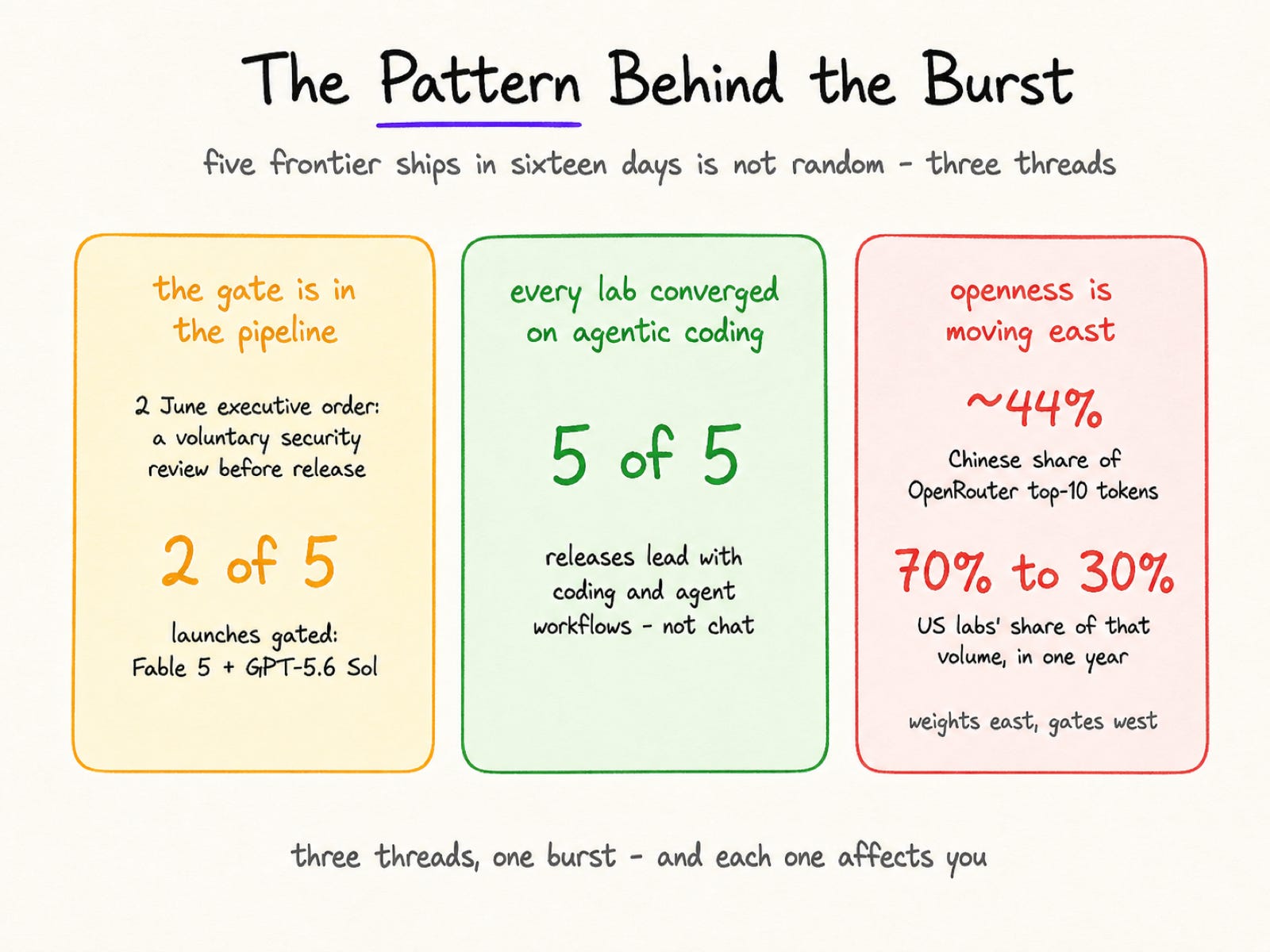
Now, five frontier ships in sixteen days is not random. I see three threads, and each one affects you.
I unpacked the first two models, one by one, in my field guide, “Five Frontier Models Shipped in Two Weeks.” Here’s What Each One Actually Is.” - so here they are in a line each. The government review is now part of the release pipeline. The voluntary security-review process from the 2 June 2026 executive order affected two of these five launches. Both focused on advanced cybersecurity. And agentic coding is where every lab converged: all five lead with coding and agent workflows rather than chat
The third thread is newer. China’s open-weight push reached frontier scale.
By June 2026, Chinese providers made up about 44% of token volume in OpenRouter’s top ten models. US labs’ share collapsed from about 70% to about 30% in a single year. My read: openness is moving east while the gates harden in the west.
You Don’t Need to Evaluate All Five This Week
Picture the alternative. You clear Saturday to try Grok 4.5 in Cursor. Sunday, a thread convinces you K3 is the real story, so you sign up there too.
By Wednesday, someone compares Sol to both. Then, your week passes with no code shipped.
I discussed this trap in “Stop Chasing Every New AI Coding Model.” Constantly switching costs you more in lost momentum than any one model can gain you.
But here’s the thing: advice like this matters most in exactly this kind of week. The louder the release cycle gets, the more a boring evaluation habit is worth.
One Caveat
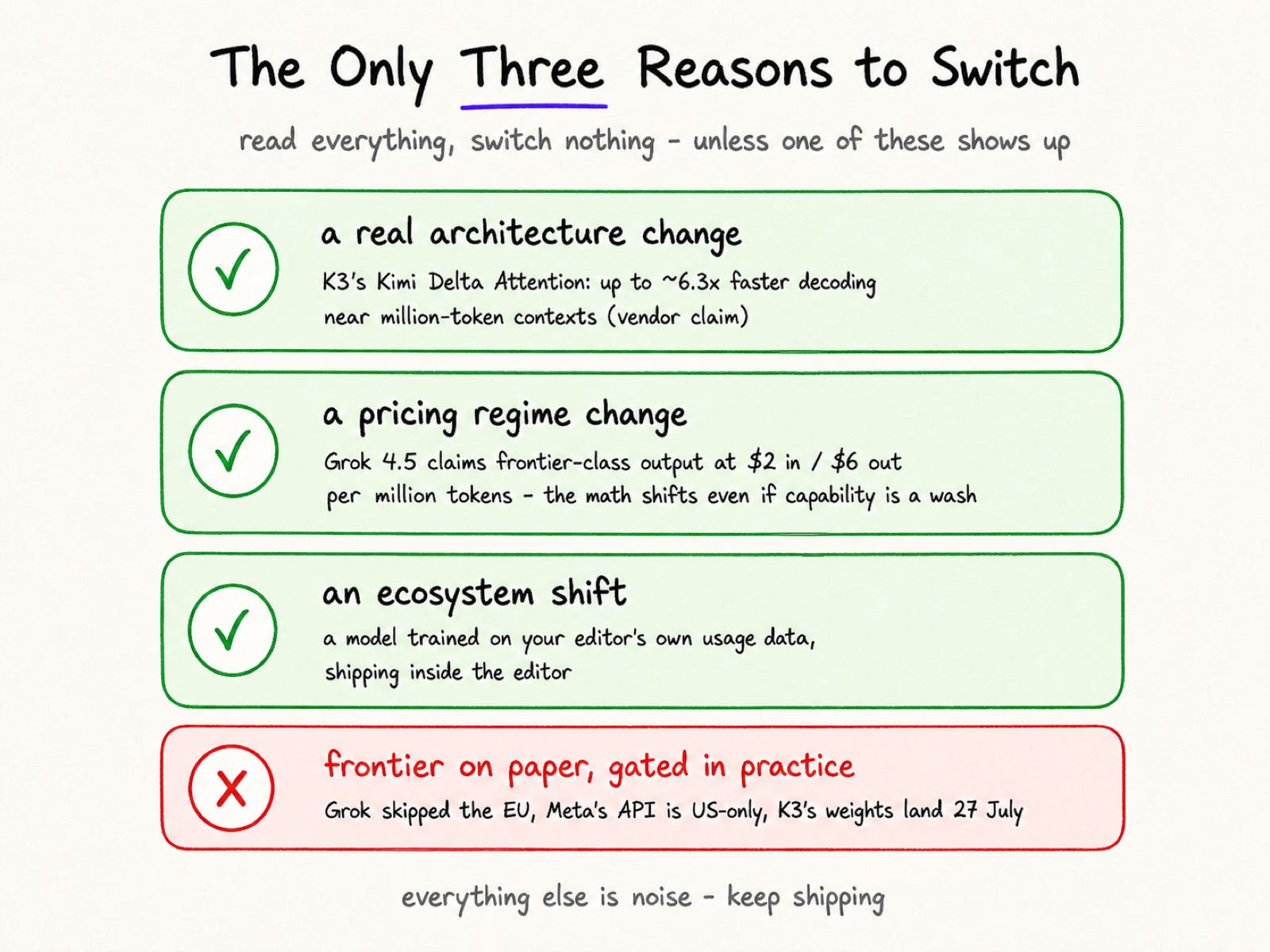
Bursts like this occasionally do contain a real step-change. There are three narrow signals I’d act on:
A genuine architecture change with measured claims. Moonshot credits K3’s Kimi Delta Attention for decoding up to 6.3 times faster when contexts reach a million tokens. If you run long-context agents, a claim like that deserves a look.
Pricing regime changes. Grok 4.5 claims frontier-class output at $2 and $6 per million tokens. This changes the math, even if the capability is simila.
Ecosystem shifts. A model trained on your editor’s usage data is included in the editor. This changes everything for anyone already using the tools.
Also keep the friction in view before you move. Grok 4.5 didn’t launch in the EU. Meta’s API is only for the US. K3 came with one expensive reasoning setting and no downloadable weights. Frontier on paper, gated in practice.
The Filter Matters More Than the Feed
Sixteen days, five frontier models, and my setup did not change once. I count that as the process working.
The models are shipping faster every quarter. Your way of judging them is the only thing that compounds.
What would it take to make you switch? Drop a comment!
Cheers friends,

Eric Roby
Find me online:
LinkedIn / YouTube / Threads
References
[1] Anthropic - Redeploying Claude Fable 5 - https://www.anthropic.com/news/redeploying-fable-5
[2] Wikipedia - GPT-5.6 - https://en.wikipedia.org/wiki/GPT-5.6
[3] Nextgov/FCW - OpenAI’s advanced GPT-5.6 models to be available to the public - https://www.nextgov.com/artificial-intelligence/2026/07/openais-advanced-gpt-56-models-be-available-public/414651/
[4] Trending Topics - SpaceXAI and Cursor launch Grok 4.5 - https://www.trendingtopics.eu/spacexai-and-cursor-launch-grok-4-5-not-yet-in-the-eu/
[5] Meta AI - Introducing Muse Spark 1.1 and the Meta Model API - https://ai.meta.com/blog/introducing-muse-spark-meta-model-api/
[6] Digital Applied - Meta Muse Spark 1.1 - https://www.digitalapplied.com/blog/meta-muse-spark-1-1-agentic-model-api-2026
[7] MarkTechPost - Moonshot AI releases Kimi K3 - https://www.marktechpost.com/2026/07/16/moonshot-ai-releases-kimi-k3-a-2-8-trillion-parameter-open-moe-model-with-kimi-delta-attention-and-1m-context/
[8] Simon Willison - Kimi K3 - https://simonwillison.net/2026/Jul/16/kimi-k3/
[9] White House - Executive Order: Promoting Advanced Artificial Intelligence Innovation and Security - https://www.whitehouse.gov/presidential-actions/2026/06/promoting-advanced-artificial-intelligence-innovation-and-security/
[10] OfficeChai - Share of US models on OpenRouter has collapsed from 70% to 30% over the past year - https://officechai.com/ai/share-of-us-models-being-used-on-openrouter-has-collapsed-from-70-to-30-over-the-past-year/